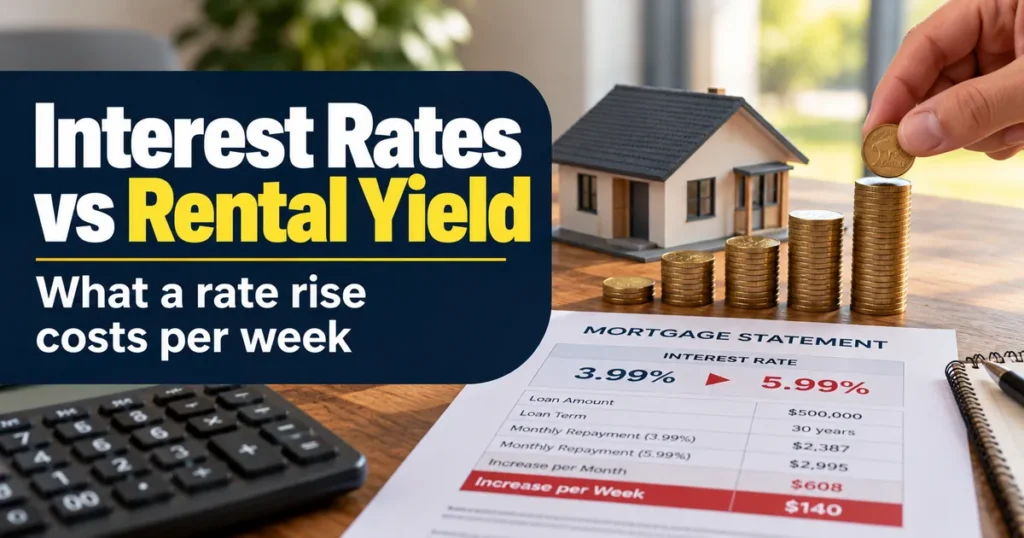
Interest rates do not change a property’s rental yield, because yield is rent against price. But they decide whether that yield covers your loan. With the RBA cash rate at 4.60% after four rises in 2026, and the average investor interest-only rate at about 7.14% (Canstar, October 2026), the yield needed to break even has risen sharply.
Key takeaways
- The net yield you need to break even before tax is roughly your interest rate x your loan to value ratio.
- At 7% with an 80% loan, that is about 5.6%. Few capital city properties reach it.
- Each 1 point rise on a $520,000 loan costs about $100 a week.
- Higher rates eventually push prices down or rents up, which lifts yields over time.
Break-even net yield at each rate
With an 80% loan, interest-only:
| Interest rate | Break-even net yield |
|---|---|
| 5% | 4.0% |
| 6% | 4.8% |
| 7% | 5.6% |
| 8% | 6.4% |
| 9% | 7.2% |
If the property’s net yield is below the figure for your rate, cash flow is negative before tax.
What rates do to cash flow
A $650,000 property renting for $600 a week (net yield 3.48%), with a $520,000 interest-only loan:
| Rate | Annual interest | Cash flow per week |
|---|---|---|
| 6% | $31,200 | -$165 |
| 7% | $36,400 | -$265 |
| 8% | $41,600 | -$365 |
| 9% | $46,800 | -$465 |
Test your own property at a rate 2 points higher than today in the rental cash flow calculator.
Why rates and yields move together over time
When rates rise, borrowing power falls, price growth slows or reverses, and more people rent. Rents tend to keep rising while prices soften, so yields drift up. Cotality reported national gross yields of 3.85% in September 2026, the highest in more than seven years. When rates fall, the reverse tends to happen.
Managing rate risk
- Build a buffer. Keep cash to cover several months of the shortfall at a higher rate.
- Consider fixing part of the loan for certainty, accepting less flexibility.
- Lift the yield. See how to increase rental yield.
- Mind your borrowing capacity. Lenders test you at a buffer above the actual rate. See how lenders assess rental income.
- Factor in tax. The 2027 negative gearing changes mean some investors will carry the full shortfall.
For current rate comparisons, see our sister site homeloaninterestrates.au.
Stress-test your rate
See your weekly cash flow at today's rate and two points higher.
Frequently asked questions
Do interest rates affect rental yield?
Not directly. Yield is rent divided by price. Rates affect your cash flow, and over time they influence prices and rents, which moves yields.
What net yield do I need to cover my mortgage?
About your interest rate multiplied by your loan to value ratio, before tax. At 7% on an 80% loan, about 5.6%.
What is the RBA cash rate now?
4.60% after the RBA’s September 2026 decision, its fourth increase in 2026. Check the RBA for any later decisions.
See what this property would yield
Enter the price, rent and costs to get gross yield, net yield and weekly cash flow.
General information only. This calculator and content do not consider your personal circumstances and are not financial, tax or legal advice. Speak to a licensed professional before making investment decisions.