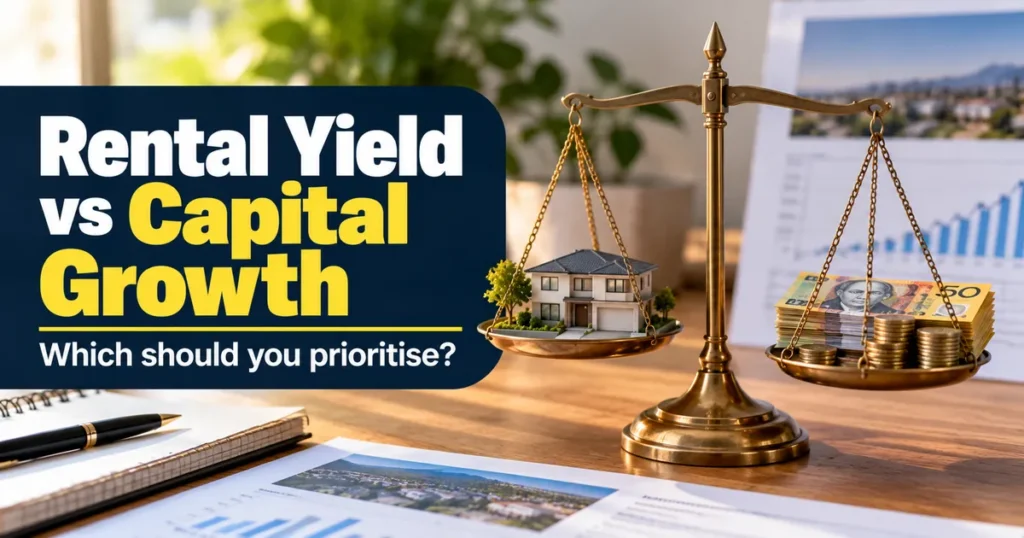
Most properties lean one way. High-yield properties earn more rent relative to their price, which helps cash flow. High-growth properties tend to rise faster in value but cost more to hold each week. Which suits you depends on how much weekly shortfall you can carry, for how long, and what you need the portfolio to do.
Key takeaways
- Yield pays the bills now. Growth builds equity later.
- A growth property only wins if you can fund the shortfall for long enough.
- Cash flow decides how many properties you can hold. Equity decides how fast you can buy the next one.
- The sweet spot is a suburb with above-average yield and genuine growth drivers.
Why yield and growth pull apart
Yield is rent divided by price. When buyers compete hard for an area, prices rise faster than rents and yields fall. That is why premium, supply-constrained suburbs often have the lowest yields, and why cheaper regional areas often have the highest. You can see the pattern in the capital city benchmarks: the most expensive cities tend to have the lowest gross yields.
A 10-year illustration
Two properties, both $750,000, both bought with an 80% loan at 7% interest-only.
| Property A: growth | Property B: yield | |
|---|---|---|
| Weekly rent | $505 | $790 |
| Gross yield | 3.50% | 5.48% |
| Net yield | 2.28% | 4.00% |
| Weekly cash flow after interest | -$479 | -$230 |
| Assumed growth per year | 6% | 3% |
| Value after 10 years | $1,343,136 | $1,007,937 |
| Capital gain | $593,136 | $257,937 |
| 10 years of cash shortfall | -$249,180 | -$119,650 |
| Gain less shortfall | $343,956 | $138,287 |
On these assumptions, Property A ends well ahead, but only if the owner can find $479 a week for ten years. Property B costs less than half of that to hold.
This is an illustration, not a forecast. It keeps rents and interest rates flat and ignores tax, depreciation and selling costs. In reality rents usually rise, which improves cash flow on both. Change the growth assumptions and the answer changes: if both grew at 4.5%, Property B would come out ahead.
When to prioritise yield
- You want to build a portfolio of several properties and need each to come close to paying for itself.
- Your income cannot comfortably absorb a large weekly shortfall, or may change.
- You are nearing retirement and want income rather than future gains.
- Borrowing capacity is your limit. Stronger rent can help with lender serviceability, although lenders typically count only part of it.
When to prioritise growth
- You have strong, stable income that can carry the shortfall for 7 to 10 years or more.
- You plan to hold for the long term and use the equity to buy again.
- You understand negative gearing and the 2027 changes, and have taken tax advice on how they apply to you.
Can you get both?
Yes, but it takes research. Look for suburbs with:
- Yield at or above the city average
- Low and falling vacancy rates
- Limited new housing supply
- Population and jobs growth
- New infrastructure such as transport, hospitals or universities
Dual-income properties and units in the right buildings can also deliver both, as can practical improvements that lift the rent on a growth property.
How to decide
- Work out the weekly shortfall you could carry for 10 years if rates rose 1 to 2 points.
- Run each candidate property through the calculator with the loan section open.
- Rule out anything whose shortfall exceeds your limit.
- Among the rest, weigh growth drivers against yield.
For the full set of metrics, including cash-on-cash return and ROI, see property investment metrics explained. And beware the idea that high yield always means low growth. It is one of several rental yield myths.
Run your own numbers
Enter the price, rent and costs to get gross yield, net yield and weekly cash flow, compared with your capital city.
Frequently asked questions
Is rental yield or capital growth more important?
Neither is more important in general. Capital growth has historically built more wealth in Australian capitals, but yield decides whether you can afford to hold the property long enough to benefit.
Can a property have high yield and high growth?
Yes, though it is less common. Look for affordable suburbs with low vacancy, limited new supply and growing population and jobs.
Why do expensive suburbs have lower rental yields?
Buyers pay a premium for location, lifestyle and expected growth, but rents do not rise as much, so rent as a share of price is lower.
See what this property would yield
Enter the price, rent and costs to get gross yield, net yield and weekly cash flow.
General information only. This calculator and content do not consider your personal circumstances and are not financial, tax or legal advice. Speak to a licensed professional before making investment decisions.