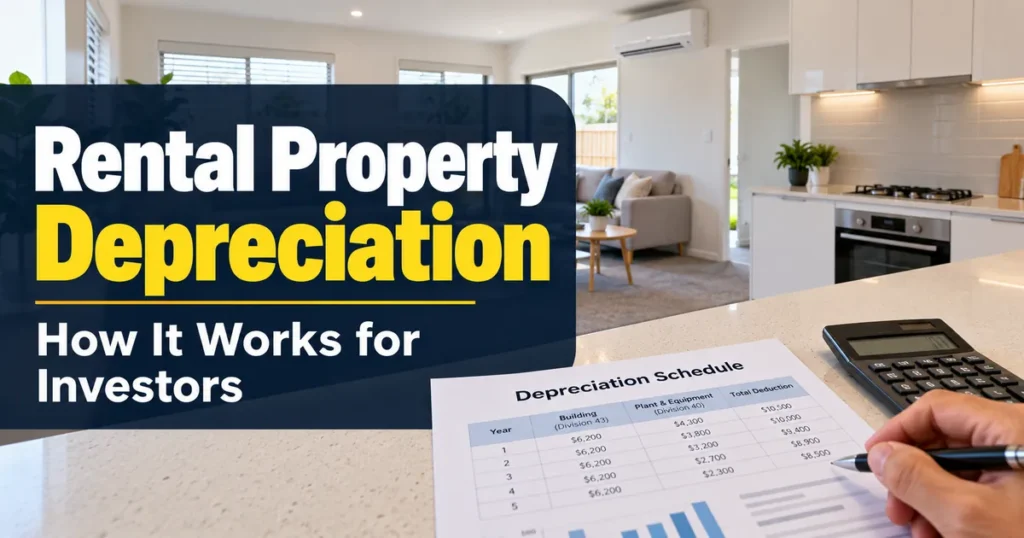
Depreciation lets you claim a tax deduction for the wear and tear on a rental property’s building and fittings, even though you do not spend any cash in that year. It does not change rental yield, but it can significantly improve after-tax cash flow. There are two types: capital works for the building, and plant and equipment for removable assets.
Key takeaways
- Capital works: generally 2.5% a year of the original construction cost for residential buildings started after 15 September 1987, for up to 40 years.
- Plant and equipment in second-hand residential properties bought after 9 May 2017 generally cannot be claimed by individual investors.
- New builds have the largest claims.
- A quantity surveyor’s report sets out what you can claim.
Capital works (Division 43)
Covers the building structure and fixed items, such as walls, roofs, kitchens and bathrooms. For residential buildings where construction started after 15 September 1987, you can generally claim 2.5% of the construction cost each year for 40 years from completion.
It is based on what the building cost to construct, not what you paid for the property. Example: a house built in 2015 for $300,000 has capital works deductions of $7,500 a year until 2055, which any later owner can claim for the remaining years.
Plant and equipment (Division 40)
Covers removable assets such as carpets, blinds, appliances, hot water systems and air conditioners. Since 9 May 2017, individual investors generally cannot claim depreciation on plant and equipment that was already in a second-hand residential property when they bought it. You can still claim assets you buy new and install yourself.
New vs older properties
| New build | Established property | |
|---|---|---|
| Capital works | Full 40 years ahead | Remaining years, if built after 1987 |
| Existing plant and equipment | Claimable | Generally not, if bought after 9 May 2017 |
| New items you install | Claimable | Claimable |
With the 2027 negative gearing changes favouring new builds, depreciation adds to their appeal for some investors. It does not make a weak investment a good one.
The effect on cash flow
Because depreciation is a non-cash deduction, it increases your tax loss (or reduces your tax profit) without costing you anything that year. In our rental cash flow example, $3,000 of depreciation at a 37% tax rate plus Medicare levy is worth about $1,170 a year.
Depreciation reduces your cost base, which can increase capital gains tax when you sell.
Getting a depreciation schedule
A registered quantity surveyor can inspect the property and prepare a depreciation schedule, usually for a few hundred dollars, which is itself tax deductible. It is most worth getting for newer properties, renovated properties and higher-value homes.
See depreciation in your cash flow
Add your depreciation estimate to see your after-tax position.
Frequently asked questions
Can I claim depreciation on an older property?
You can claim capital works on buildings constructed after 15 September 1987 for the remainder of their 40 years, plus any new assets you install. Existing plant and equipment generally cannot be claimed if bought after 9 May 2017.
Does depreciation affect rental yield?
No. Yield uses rent, costs and price. Depreciation affects tax and after-tax cash flow.
Do I need a quantity surveyor?
To claim capital works when you do not know the construction cost, yes. The ATO accepts estimates from qualified quantity surveyors.
See what this property would yield
Enter the price, rent and costs to get gross yield, net yield and weekly cash flow.
General information only. This calculator and content do not consider your personal circumstances and are not financial, tax or legal advice. Speak to a licensed professional before making investment decisions.