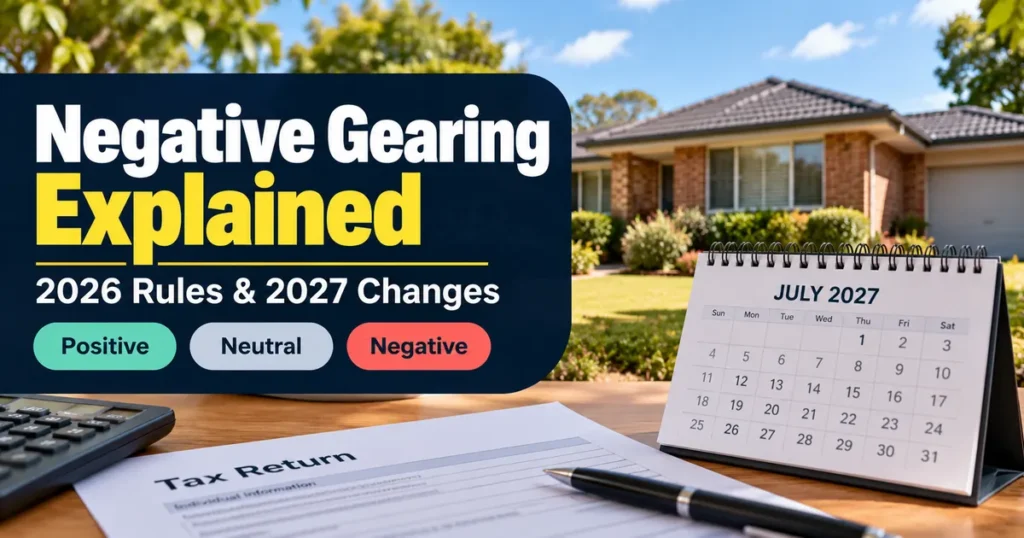
A property is negatively geared when its costs, including loan interest, are more than its rent. The loss has been deductible against your other income, such as salary, which reduces your tax. Laws passed in June 2026 change that for many future purchases: from 1 July 2027, negative gearing on residential property is limited to new builds, with existing holdings grandfathered.
Key takeaways
- Negative gearing means rent does not cover costs and interest. You fund the gap, and part of it has come back as a tax saving.
- Positive gearing means the property earns a taxable profit.
- From 1 July 2027, losses on established residential properties bought after the 2026 Budget can no longer reduce tax on other income.
- Properties held at the 2026 Budget, and new builds, keep access to negative gearing.
- The 50% CGT discount is replaced with indexation and a 30% minimum tax for gains from 1 July 2027.
Positive, neutral and negative gearing
| Rent vs costs and interest | Tax effect | |
|---|---|---|
| Positively geared | Rent is more | Profit is taxed |
| Neutrally geared | Roughly equal | Little tax effect |
| Negatively geared | Rent is less | Loss reduces tax on other income (subject to the 2027 rules) |
Worked example
A $650,000 property renting for $600 a week, 80% loan at 7% interest-only, $3,000 a year depreciation, owner on the 37% tax rate.
| Per year | |
|---|---|
| Net income before interest | $22,600 |
| Interest | -$36,400 |
| Cash flow before tax | -$13,800 |
| Depreciation | -$3,000 |
| Taxable loss | -$16,800 |
| Tax saving at 37% + 2% Medicare | $6,552 |
| Cash flow after tax | -$7,248, about $139 a week |
Without negative gearing, the owner would carry the full $265 a week, with the loss carried forward to use against future residential property income or gains. Model your own numbers in the rental cash flow calculator.
The 2026 reforms
The Treasury Laws Amendment (Tax Reform No. 1) Bill 2026 passed parliament on 25 June 2026. In summary:
- From 1 July 2027, negative gearing for residential property is limited to new builds.
- Grandfathering: properties held at the 12 May 2026 Budget keep their current treatment. Investors who bought between Budget night and 1 July 2027 can negatively gear until that date.
- Losses on affected properties can only be used against residential rental income and residential capital gains, and can be carried forward.
- New builds include greenfield homes, off-the-plan apartments and some knock-down rebuilds that add dwellings.
- Capital gains: for gains from 1 July 2027, the 50% CGT discount is replaced with cost base indexation and a 30% minimum tax on capital gains.
- Not affected: commercial property, shares and superannuation funds.
Some details, including grandfathering for jointly owned properties and further carve-outs, are being finalised in follow-up legislation. Check the Treasury consultation page and the ATO, and get personal tax advice.
What it means for strategy
- Yield matters more. If losses cannot reduce other income, the full weekly shortfall falls on you. Higher rental yields and positive cash flow become more valuable.
- New builds gain an edge for investors who want to negatively gear, along with stronger depreciation.
- Granny flats and dual occupancy may help. Adding a dwelling can count as a new build in some cases. See the granny flat calculator.
- Growth strategies need deeper pockets. Revisit rental yield vs capital growth with after-tax numbers.
Model your cash flow after tax
See your weekly cost before and after tax, under the current and 2027 rules.
Frequently asked questions
Is negative gearing being abolished?
Not entirely. From 1 July 2027 it is limited to new builds for residential property. Existing holdings at the 2026 Budget are grandfathered, and commercial property and shares are unaffected.
Can I still negatively gear a property I bought in 2025?
Yes. Properties held before the 12 May 2026 Budget are grandfathered. Check the details with your accountant.
What happens to losses that cannot be negatively geared?
They can be used against residential rental income and residential capital gains, and carried forward to future years.
What is positive gearing?
When rent exceeds all costs including interest, so the property makes a taxable profit and adds to your income.
See what this property would yield
Enter the price, rent and costs to get gross yield, net yield and weekly cash flow.
General information only. This calculator and content do not consider your personal circumstances and are not financial, tax or legal advice. Speak to a licensed professional before making investment decisions.