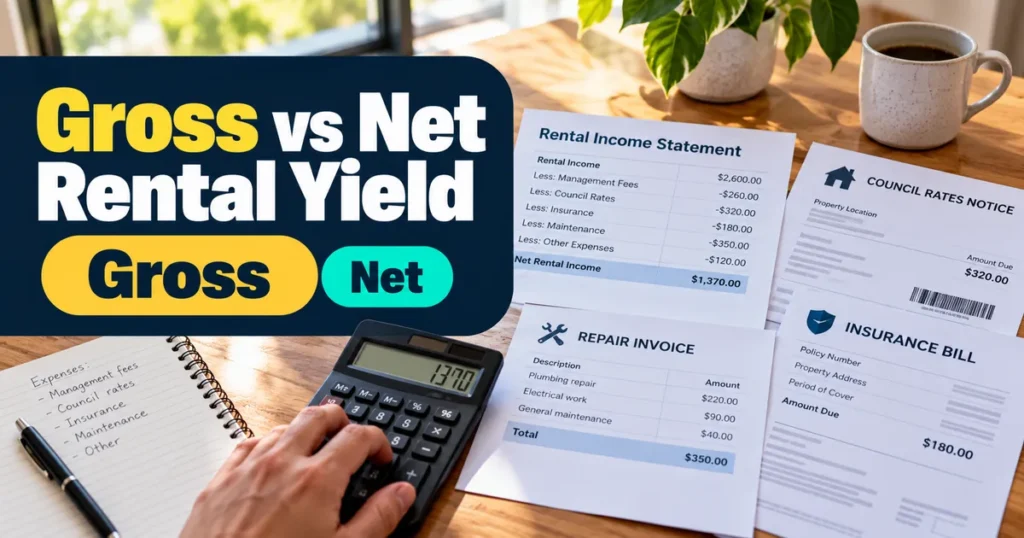
Gross rental yield is annual rent divided by the property price. Net rental yield takes the costs of owning the property off the rent first. Gross yield is quick for comparing properties. Net yield tells you what the property actually returns before finance.
Key takeaways
- Gross yield = annual rent / price x 100
- Net yield = (annual rent – vacancy – running costs) / price x 100
- Net yield is typically 1 to 2 percentage points lower than gross.
- Neither figure includes loan interest. Check cash flow separately.
The formulas
| Gross rental yield | Net rental yield | |
|---|---|---|
| Formula | Annual rent / price x 100 | (Annual rent – vacancy – costs) / price x 100 |
| Includes costs | No | Yes |
| Includes loan interest | No | No |
| Best for | Shortlisting and comparing with benchmarks | Deciding whether a property stacks up |
Worked example
Take a house priced at $750,000 renting for $650 a week.
Gross yield
- Annual rent: $650 x 52 = $33,800
- $33,800 / $750,000 = 0.0451
- Gross yield = 4.51%
Net yield
Now take off the costs:
| Cost | Per year |
|---|---|
| Vacancy (2 weeks) | $1,300 |
| Council rates | $2,200 |
| Water rates | $900 |
| Landlord insurance | $1,800 |
| Property management (7% of rent collected) | $2,275 |
| Maintenance | $1,500 |
| Total | $9,975 |
- Net income: $33,800 – $9,975 = $23,825
- $23,825 / $750,000 = 0.0318
- Net yield = 3.18%
Same property, a 1.33 point difference. That gap is money that leaves your account every year, which is why gross yield on its own can make a property look better than it is.
What goes into net yield
Include costs the landlord pays to own and rent out the property:
- Vacancy (weeks without a tenant)
- Property management fees and leasing fees
- Council rates and water service charges
- Landlord insurance
- Strata levies for units and townhouses
- Repairs and maintenance
- Land tax, if it applies to you
Leave out loan interest, tax and depreciation. Those depend on you, not the property.
Why net yield excludes loan interest
It is a common point of confusion. Net yield measures how the property performs, so two investors with different loans get the same answer for the same property. Your loan affects your cash flow, which is a separate figure.
In the example above, an 80% loan at 7% interest-only costs $42,000 a year in interest. Net income of $23,825 less $42,000 is a shortfall of $18,175 a year, or about $350 a week. The property has a reasonable net yield, but you would need to fund that shortfall. Our calculator shows both figures side by side, and the rental cash flow calculator adds the tax effect.
When to use each
- Gross yield: scanning listings, comparing suburbs, and checking against published benchmarks, which are almost always gross.
- Net yield: comparing two properties you are seriously considering, especially a house against a unit with strata.
- Cash flow: deciding whether you can afford to hold the property.
For more ways to measure a property, including cap rate and cash-on-cash return, see property investment metrics explained. For five more worked examples, see rental yield examples.
Calculate gross and net yield
Enter your price, rent and costs to see both yields and your weekly cash flow.
Frequently asked questions
Is net rental yield always lower than gross?
Yes. Net yield starts from the same rent and takes costs off, so it is always lower unless costs are zero.
What is a typical gap between gross and net yield?
For most residential properties, 1 to 2 percentage points. Units with high strata levies and older properties can have a bigger gap.
Does net rental yield include stamp duty?
No. Published yields divide by the purchase price. To include stamp duty and other purchase costs, calculate yield on cost instead.
Which yield do real estate agents quote?
Usually gross yield, because it is simpler and higher. Always work out the net figure yourself.
See what this property would yield
Enter the price, rent and costs to get gross yield, net yield and weekly cash flow.
General information only. This calculator and content do not consider your personal circumstances and are not financial, tax or legal advice. Speak to a licensed professional before making investment decisions.