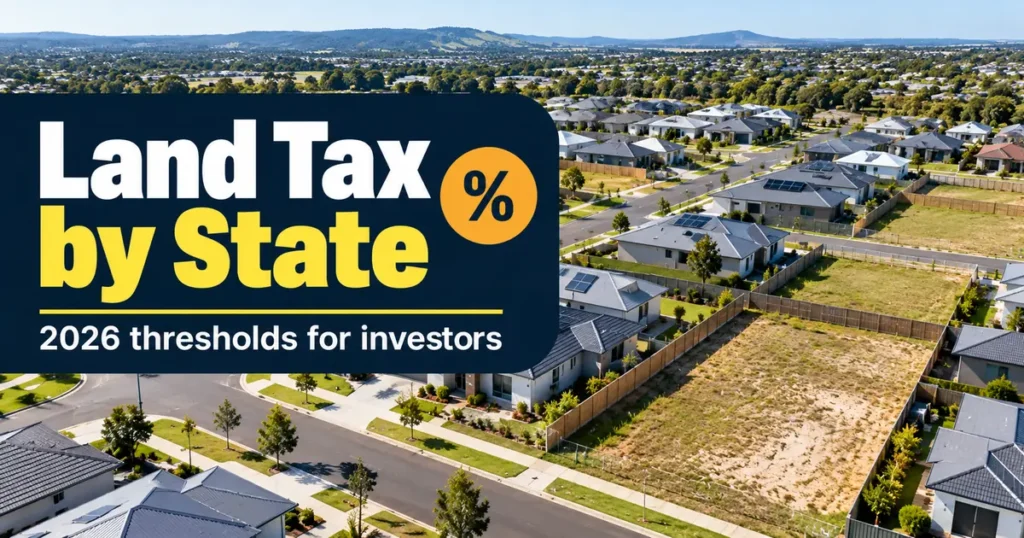
Land tax is an annual state tax on land you own other than your home. Each state sets its own threshold, rates and rules, and it is calculated on the total value of all the taxable land you own in that state, not property by property. For many investors it is the cost that turns a second or third property’s net yield from solid to thin.
Key takeaways
- Land tax is charged on land value, not the property price, and on your combined holdings in each state.
- Thresholds range from no threshold for rented land in the ACT to over $1 million in NSW.
- The Northern Territory has no land tax.
- Spreading holdings across states can keep each state’s total under its threshold.
- Add land tax to the calculator as a running cost. It comes straight off net yield.
Thresholds by state and territory
| State | Threshold for individuals | Applies to | How it starts |
|---|---|---|---|
| NSW | $1,075,000 | 2026 land tax year | $100 plus 1.6% of land value above the threshold |
| VIC | $50,000 | 2026 land tax year | Flat amounts at low values, then rising rates. Includes COVID debt levy charges until 2033. |
| QLD | $600,000 | 2026-27 | $500 plus 1% of value above $600,000, up to $1 million |
| SA | $936,000 | 2026-27 | 0.5% above the threshold, rising in steps |
| WA | $300,000 | 2026-27 | $300 flat up to $420,000, then $300 plus 0.25% |
| TAS | $125,000 | 2026-27 | $50 plus 0.45% above the threshold |
| ACT | No threshold for rented residential land | 2026-27 | A fixed charge plus a rate on land value |
| NT | No land tax |
Companies, trusts and foreign owners often face lower thresholds or surcharges. Thresholds change every year, so check the current figures with your state revenue office (NSW link; each state has its own) before relying on them.
Worked examples
NSW: an investor owns two rentals with combined land value of $1,200,000. Land tax is $100 plus 1.6% of $125,000 = $2,100 a year.
QLD: an individual owns Queensland investment land worth $700,000. Land tax is $500 plus 1% of $100,000 = $1,500 a year.
On a $650,000 property, $2,100 of land tax takes about 0.3 percentage points off net yield. See how in the net rental yield calculator.
How land tax works
- Land value, not price. Tax is based on the unimproved land value set by the state valuer, which is usually well below the purchase price, especially for units.
- Aggregation. All your taxable land in a state is added together. That is why the first property often pays nothing and the next one triggers a bill.
- Your home is usually exempt. Primary production land often is too.
- Ownership structure matters. Trusts and companies are often taxed at higher rates or lower thresholds.
- Units carry less land. Each unit owner is taxed on a share of the land, so land tax is usually small for apartments. That is one reason units vs houses compare differently on net yield.
Ways investors manage land tax
- Spread across states. Each state has its own threshold.
- Check valuations. If a land valuation looks too high, you may be able to object within the time allowed.
- Choose ownership carefully. Joint ownership, companies and trusts are treated differently. Get advice before buying.
- Budget for it. Put land tax into every net yield calculation, even if it is zero today.
See what land tax does to your yield
Add land tax as a running cost to see your net yield and cash flow.
Frequently asked questions
Do I pay land tax on my first investment property?
Often not, if its land value is under your state’s threshold. Land tax usually starts once your combined taxable land in a state passes the threshold. The ACT is an exception: rented residential land is taxed from the first dollar.
Is land tax tax deductible?
Land tax on a rental property is generally a deductible expense against rental income. Check with your accountant.
Which state has no land tax?
The Northern Territory does not charge land tax.
Is land tax based on the purchase price?
No. It is based on the land value set by the state valuer, which excludes the building.
See what this property would yield
Enter the price, rent and costs to get gross yield, net yield and weekly cash flow.
General information only. This calculator and content do not consider your personal circumstances and are not financial, tax or legal advice. Speak to a licensed professional before making investment decisions.