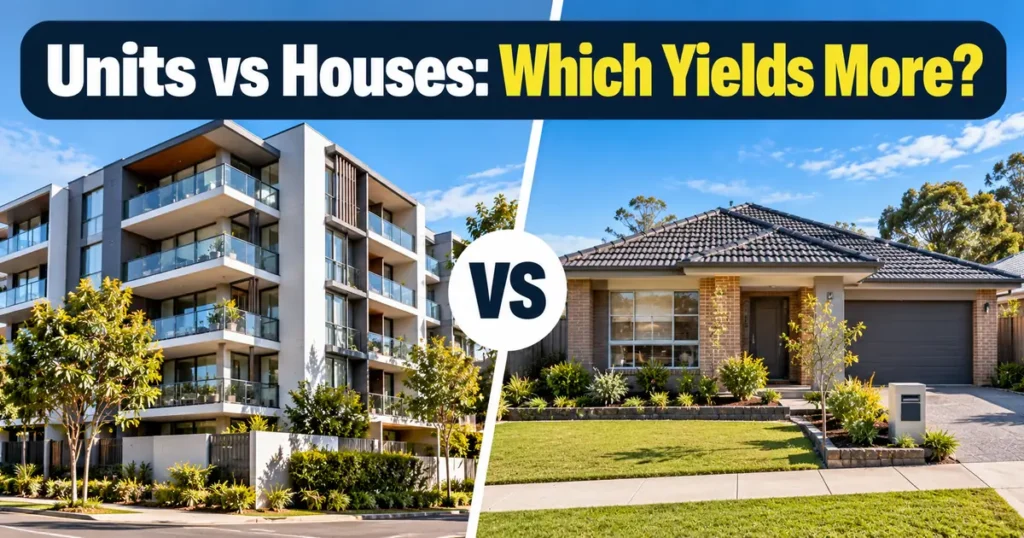
Units almost always have a higher gross rental yield than houses, because they cost less to buy relative to the rent they earn. As at September 2026, capital city units averaged about 4.7% gross, compared with about 3.4% for houses. But strata levies narrow the gap on a net basis, and houses have historically delivered stronger capital growth.
Key takeaways
- Units lead on gross yield in every capital city.
- Strata levies can cut a unit’s yield advantage by more than half on a net basis.
- Units have lower entry prices and often smaller weekly shortfalls in dollar terms.
- Houses own more land, which has historically driven more capital growth.
Side-by-side example
A unit and a house, both bought with an 80% loan at 7% interest-only.
| Unit | House | |
|---|---|---|
| Price | $600,000 | $900,000 |
| Weekly rent | $620 | $700 |
| Annual rent | $32,240 | $36,400 |
| Strata levies | $5,000 | $0 |
| Total vacancy and running costs | $12,210 | $10,650 |
| Gross yield | 5.37% | 4.04% |
| Net yield | 3.34% | 2.86% |
| Weekly cash flow after interest | -$261 | -$474 |
The unit’s gross yield is 1.33 points higher. After costs, its lead shrinks to 0.48 points, mostly because of the $5,000 strata bill. Strata covers building insurance and common area upkeep, so the unit owner’s insurance and maintenance are lower, but not by enough to offset the levies. Still, the unit costs about $213 a week less to hold.
You can run this comparison yourself in the calculator by entering each property in turn.
Why units yield more
- Lower prices. Rents for units are lower than for houses, but prices are lower by an even bigger margin.
- Strong renter demand. Smaller households, students, young professionals and downsizers all rent units, particularly near transport and jobs.
- Less land. Much of a house’s value is land, which earns no extra rent but tends to grow in value.
Why houses often grow faster
A house’s land component is scarce, especially in established suburbs, and land is what has historically driven most capital growth. Unit values depend more on supply: if many similar apartments are built nearby, prices and rents can stall. That is why yield and growth often pull in opposite directions.
What to check before buying a unit
- Strata levies and history. Ask for the last few years of levies, the sinking fund balance and any special levies planned.
- Building defects. Read strata minutes and any building reports, especially for newer high-rise buildings.
- Local supply. A pipeline of similar new apartments can cap rents and growth.
- Owner-occupier ratio. Buildings with more owner-occupiers are often better maintained.
- Net yield, not gross. Always run the full numbers. See gross vs net rental yield.
What to check before buying a house
- Maintenance. You pay for the roof, gutters, fences and garden yourself. Budget for it.
- Land tax. Larger land holdings push more investors over state thresholds. See land tax by state.
- Second income potential. Some blocks allow a granny flat or dual occupancy, which can lift yield. See how to increase rental yield.
Which is better for you?
- Choose a unit if you have a smaller deposit, want lower weekly holding costs or are building a cash flow focused portfolio, and you can find a well-run building with reasonable levies.
- Choose a house if you can carry a larger shortfall and are investing for long-term growth.
For current yields by city, see what is a good rental yield in Australia.
Compare a unit and a house
Enter each property's price, rent and costs, including strata, to compare net yield and cash flow.
Frequently asked questions
Do units have higher rental yields than houses?
Yes, on a gross basis units have higher yields than houses in every Australian capital city. The gap is smaller on a net basis because of strata levies.
Are units a good investment in Australia?
They can be, especially for cash flow, but quality varies widely. Check strata finances, building condition and nearby supply before buying.
Why do houses have lower rental yields?
Much of a house’s price is land, which does not earn extra rent. Investors pay for the land because it has historically driven capital growth.
See what this property would yield
Enter the price, rent and costs to get gross yield, net yield and weekly cash flow.
General information only. This calculator and content do not consider your personal circumstances and are not financial, tax or legal advice. Speak to a licensed professional before making investment decisions.