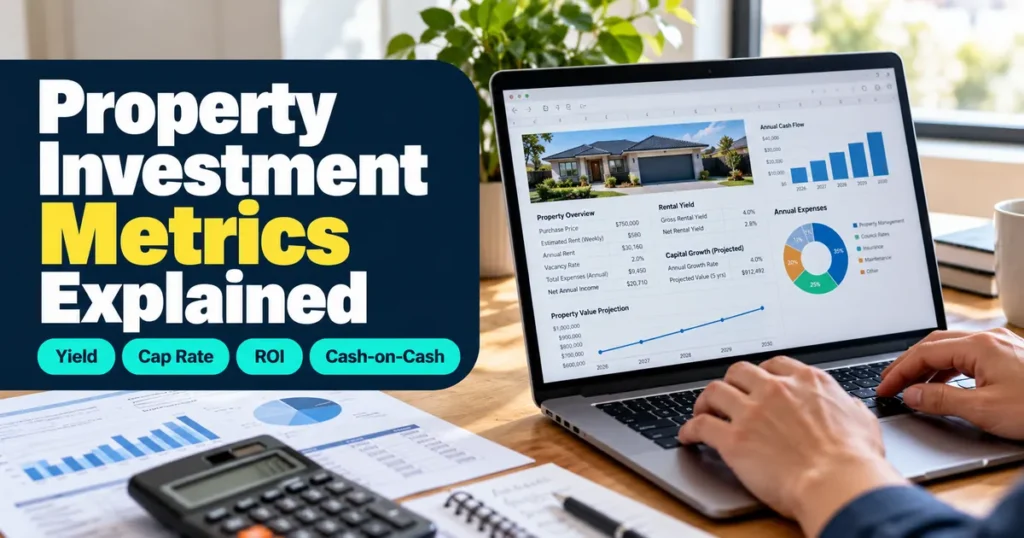
Rental yield tells you how much rent a property earns relative to its price. It does not tell you the return on your money, or whether the property will make you wealthier. For that you need a few more metrics. Here they are, all calculated on the same property so you can see how they relate.
Key takeaways
- Gross and net yield measure the property.
- Cap rate is effectively net yield, a term borrowed from commercial property.
- Yield on cost includes stamp duty and purchase costs.
- Cash-on-cash return measures the cash return on the money you put in, after interest.
- ROI adds capital growth to the picture.
The example property
| Item | Figure |
|---|---|
| Purchase price | $650,000 |
| Weekly rent | $600 |
| Annual rent | $31,200 |
| Vacancy and running costs | $8,600 |
| Net operating income | $22,600 |
| Loan (80%) at 7% interest-only | $520,000, $36,400 a year interest |
| Deposit | $130,000 |
| Stamp duty and purchase costs (illustrative) | $28,000 |
| Total cash invested | $158,000 |
Stamp duty varies a lot by state and price, so treat the $28,000 as an example only.
1. Gross rental yield
Annual rent / price x 100
$31,200 / $650,000 = 4.80%
Quick and comparable with published benchmarks. Ignores costs.
2. Net rental yield
(Annual rent – vacancy – running costs) / price x 100
$22,600 / $650,000 = 3.48%
The property’s real income return before finance. See gross vs net rental yield.
3. Cap rate
Net operating income / property value x 100
$22,600 / $650,000 = 3.48%
Cap rate is the commercial property name for the same idea as net yield. You will see it in commercial listings and valuations. Commercial definitions of net operating income can vary slightly, for example in how outgoings recovered from tenants are treated, so check how a quoted cap rate was worked out.
4. Yield on cost
Net operating income / (price + purchase costs) x 100
$22,600 / $678,000 = 3.33%
Yield on cost is lower than net yield because stamp duty and fees are part of what you paid. It is useful when comparing a purchase with a build or renovation, where the total cost is what matters.
5. Cash-on-cash return
Annual pre-tax cash flow / cash invested x 100
Cash flow: $22,600 net income – $36,400 interest = -$13,800
-$13,800 / $158,000 = -8.7%
Cash-on-cash return is the return on your own money in the year, from rent alone. It is negative here because interest is more than net income, which is common for capital city property at current rates. It ignores capital growth and tax.
6. Return on investment (ROI)
(Cash flow + capital growth) / cash invested x 100
Say the property grows 4% in the first year, adding $26,000 in value.
(-$13,800 + $26,000) / $158,000 = 7.7%
ROI brings growth into the picture, which is why investors accept negative cash flow. The growth figure here is an assumption, not a forecast. Growth is uncertain and only realised when you sell or borrow against it. More on this trade-off in rental yield vs capital growth.
Which metric should you use?
| Question | Metric |
|---|---|
| Is this listing worth a closer look? | Gross yield |
| How does it compare with another property? | Net yield |
| Is this commercial property priced fairly? | Cap rate |
| Does this build or renovation stack up? | Yield on cost |
| Can I afford to hold it, and what do I earn on my cash? | Cash flow and cash-on-cash return |
| Will this make me wealthier over time? | ROI, with realistic growth assumptions |
The calculator gives you gross yield, net yield and cash flow. For commercial property, use the commercial yield calculator, and for after-tax cash flow, the rental cash flow calculator. For five more worked properties, see rental yield examples. For definitions of every term, see the glossary.
Run your own numbers
Enter the price, rent and costs to get gross yield, net yield and weekly cash flow, compared with your capital city.
Frequently asked questions
Is cap rate the same as rental yield?
Cap rate is the same as net rental yield in most residential cases: net operating income divided by value. Gross yield is different because it ignores costs.
What is a good cash-on-cash return?
Any positive figure means the property pays you from rent alone. Many capital city properties are negative at current interest rates, with investors relying on growth instead.
Why is ROI higher than rental yield?
ROI includes capital growth and measures return on your cash, not the full price. Leverage magnifies the result, in both directions.
See what this property would yield
Enter the price, rent and costs to get gross yield, net yield and weekly cash flow.
General information only. This calculator and content do not consider your personal circumstances and are not financial, tax or legal advice. Speak to a licensed professional before making investment decisions.